In most manufacturing and agribusiness sectors (including palm oil), belt transmission systems (V-Belts) are the mechanical backbone that drives everything from pumps to large fans. Despite their crucial role, choosing the correct V-belt size is very often overlooked, resulting in premature wear, slipping, and loss of mechanical power transfer.
To the naked eye, many V-Belts look similar. However, small differences in top width, thickness, and cross-sectional angle can have a fatal impact on the lifespan of the belt and the integrity of the pulley. This guide will help you understand how to measure, read dimension codes, and compare various types of industrial V-Belts so you don't make the wrong purchase.

Understanding Basic V-Belt Profiles
Classic V-Belts are generally classified with alphabet letters (M, A, B, C, D, E) for the American and ISO standardization markets, while modern, narrower, and high-power profiles (wedge belts) are typically designated with codes SPA, SPB, SPC, and SPZ. These two families of V-Belts cannot be swapped indiscriminately even though at first glance they might fit into the same pulley groove.
Aspects of the V-Belt profile worth noting:
- Top Width: The maximum width on the outer surface of the belt.
- Depth / Thickness: The distance from the top surface to the bottom.
- V-Angle: Averages 40 degrees so the belt can be gripped tightly by the pulley walls when under tension, minimizing slip.
Standard V-Belt Dimensions Table
| V-Belt Type | Top Width (mm) | Height / Thick (mm) | Angle (Degrees) |
|---|---|---|---|
| Type M (Classic) | 10 mm | 5.5 mm | 40° |
| Type A (Classic) | 13 mm | 8.0 mm | 40° |
| Type B (Classic) | 17 mm | 11.0 mm | 40° |
| Type C (Classic) | 22 mm | 14.0 mm | 40° |
| Type SPZ (Wedge) | 9.7 mm | 8.0 mm | 40° |
| Type SPA (Wedge) | 13.0 mm | 10.0 mm | 40° |
| Type SPB (Wedge) | 16.3 mm | 13.0 mm | 40° |
As a quick identification guide: If you have a classic V-Belt with a top width of about one and a half centimeters, then it is most likely a Type B.
How to Read International Size Codes
How manufacturers list length measurements on the back of belts is often confusing for users. There are three main methods:
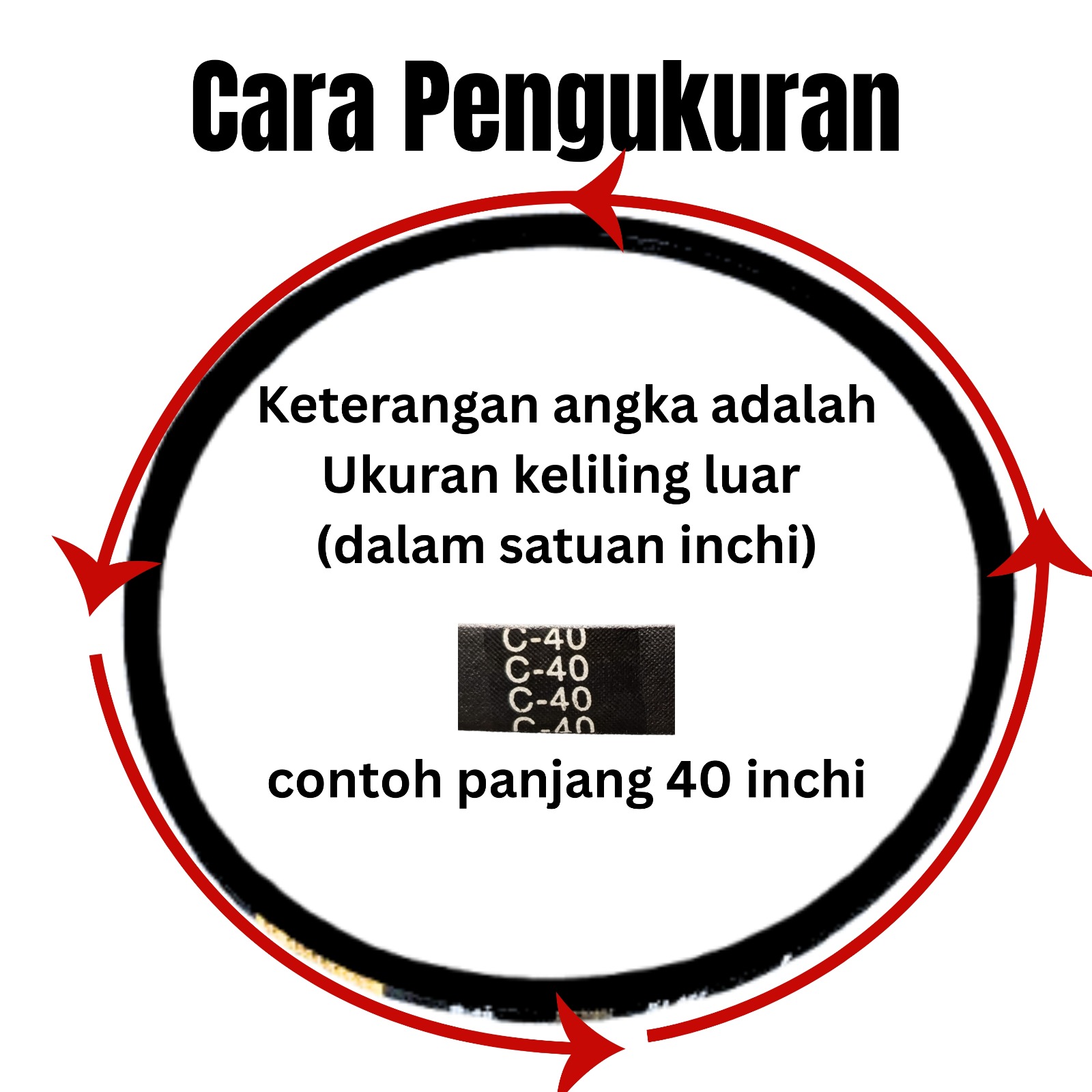
1. Classic Inch System (Inside Length / Li)
This system is the most popular. The V-Belt is given a letter code followed by a number (e.g., B-60). Meaning: This is a type B cross-section V-belt, with an inside length (Li) of the belt stretching 60 inches.
2. European / ISO Standard System (Pitch Length / Lw / Lp)
Typically used for metric types and SP (narrow wedge) belts. Example: SPA 1500. Meaning: A Type SPA V-Belt with a pitch length (the neutral axis of the belt's tension) of 1500 millimeters.
Practical Steps to Manually Measure a V-Belt
If the part number on your old V-belt has faded or completely rubbed off, how do you know the replacement size? Follow this procedure:
- 1. Measure Top Width: Use a vernier caliper to measure the remaining widest outer part of the belt. Match it with the standard table (e.g., measuring 17 mm = Type B).
- 2. Use a String to Measure the Circumference: If the belt is broken, wrap a non-elastic string around the pulley track according to the installation tension setup. Measure the length of that string and you will get the Outside Length (La) of your system.
- 3. Convert: Subtract the outside circumference according to the V-Belt profile thickness formula to get the pitch length or inside length used to order the item.
Very briefly, for A v-belts: Outside Length (La) = Inside Length (Li) + 2 inches. For B V-belts: La = Li + 2.7 inches.
Why Do V-Belts Break / Wear Out Very Quickly?
Errors in selecting size and type are not the only reasons for massive V-Belt failure.
- Misaligned Pulleys: Causes heavy friction on one side of the belt wall.
- Under-Tension: The belt will slip and trigger high heat due to friction with metal.
- Over-Tension: The belt will not slip, but excessive tension will cause the inner cords (polyester wire) to snap and can damage machine bearings.
Perfect installation is crucial. Always install a set of V-Belts at the same time (matched-set) using the same brand, and ensure pulley alignment has been verified with a laser alignment tool.
Conclusion
Ordering industrial V-Belts must be precise, paying attention to the width cross-section (like Type A, B, or SPA) as well as the interpretation of belt length measurements (Li vs Lp vs La). For the best durability in high operational temperatures and humidity of heavy equipment (e.g., in Palm Oil Mills), use premium product lines like OMEGA V-Belts which have been reinforced with high tensile polyester cords.